
TMS for OCD Treatment: Who It’s For and How It Works
Clinically reviewed by

Caleb Whitenack, MD
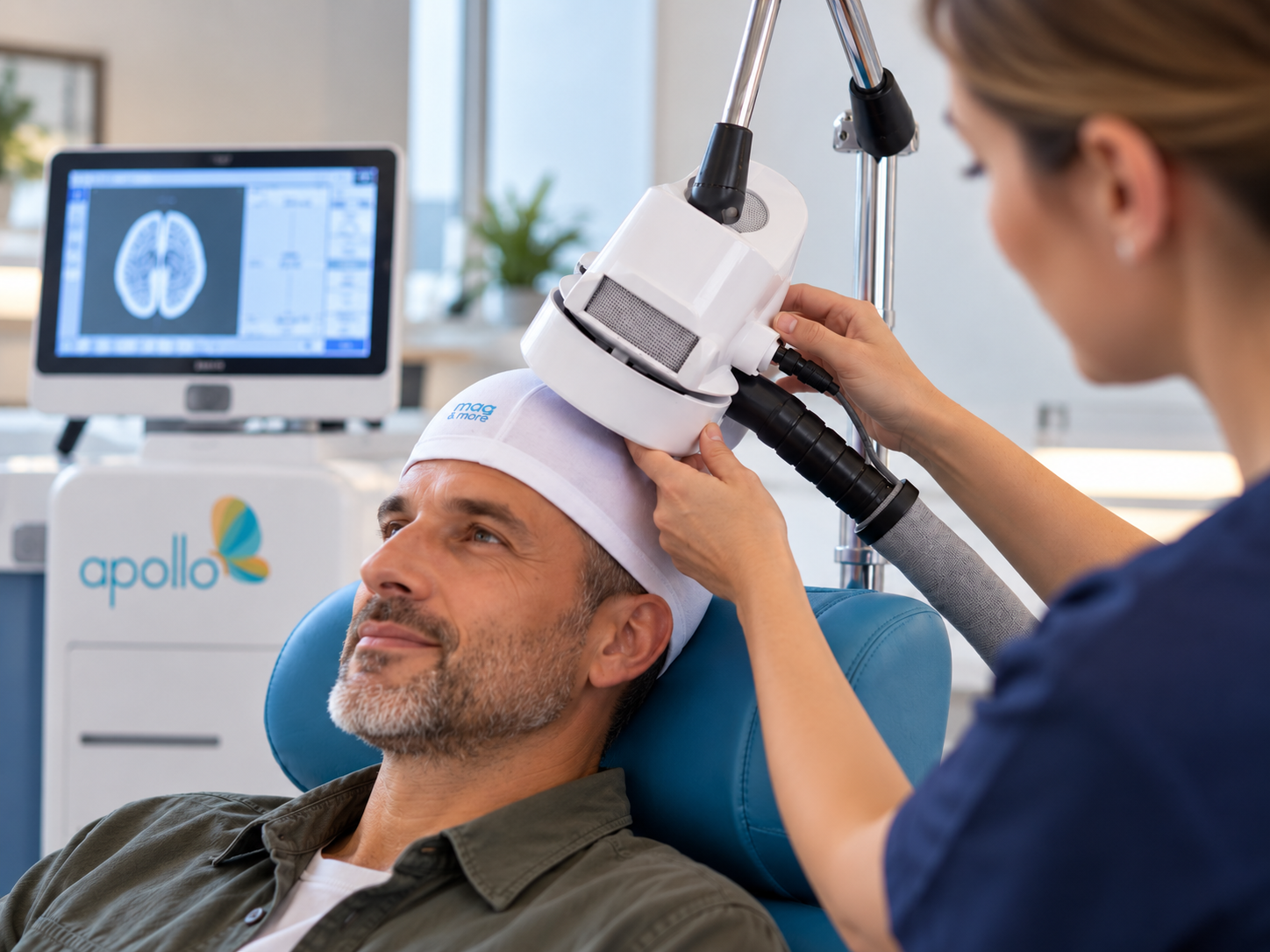
If you’ve done the therapy, tried the medications, and your OCD still takes up hours of your day, you may be wondering what’s left. Many people have only heard of TMS as a depression treatment, so it’s easy to miss that it’s also an established option for OCD. This guide covers how it works, who it’s meant for, and what to realistically expect.
Is TMS for OCD FDA-Approved?
TMS is FDA-cleared for OCD, which is the form of authorization the FDA uses for devices like this one. In 2018, the FDA cleared TMS as an option for people whose OCD hasn’t responded to traditional treatments. You’ll often see it called “FDA-approved” online, and either way it means the FDA reviewed the evidence and permitted TMS to be used for OCD.

How TMS Therapy for OCD Differs From TMS for Depression
The basic way TMS works is the same for both conditions: a magnetic coil held against your head sends pulses that change activity in targeted areas of the brain. What changes with OCD is where those pulses go and what happens right before them. According to the International OCD Foundation, the FDA-cleared OCD protocols aim at the dorsomedial prefrontal cortex or the anterior cingulate cortex, and each session begins with a short provocation of OCD fears. More than one TMS system is now cleared for OCD, and the coils used are designed to reach deeper into the brain than standard coils, which is why you’ll often see it called deep TMS.
The provocation is planned with you ahead of time. Before each session, you briefly face a personalized trigger, such as a thought or object tied to your OCD, so the circuit being targeted is active when the pulses arrive. It’s uncomfortable on purpose, and it may feel familiar if you’ve done ERP.
TMS vs. ERP for OCD: Why They Work Together
Exposure and response prevention or ERP is a form of therapy in which you gradually face OCD triggers while resisting the compulsion. Along with medication, it remains a first-line treatment for OCD, and TMS is meant to build on that work. Research suggests TMS for OCD tends to show its strongest results when it’s added to ongoing treatment, which is why it’s usually offered as an add-on to ERP, medication, or both.
In practice, you’d typically keep seeing your therapist and keep taking any prescribed medication during a TMS course. Any change to either should be a joint decision with your provider.
Is TMS Right for Treatment-Resistant OCD?
Treatment-resistant OCD generally means symptoms haven’t improved after trying several treatment options. That’s the group TMS for OCD was designed for. A provider may consider it if:
- You’ve completed a full course of ERP with a trained therapist
- You’ve tried medication long enough, at a dose your prescriber considered adequate
- Your OCD still takes up significant time or gets in the way of work, relationships, or daily life
- You don’t have metal implants or stimulator devices in or near your head
If you’ve had seizures, bring that up early, since it’s part of how a provider weighs whether TMS is safe for you. The same goes for depression or other conditions you’re managing alongside OCD.
What a Course of TMS Therapy for OCD Looks Like
Sessions usually happen five days a week for four to six weeks. Each visit starts with your personalized provocation, followed by roughly 18 minutes of stimulation while you sit in a chair wearing earplugs. You’ll hear loud clicking and feel a tapping sensation on your scalp, and you can return to your normal day right after.
Like any TMS course, it follows a predictable week-by-week rhythm, with the provocation step added at the start of each visit. Because TMS needs the device and trained staff, every session happens in person, so plan for a daily trip to the clinic during the course.
Does TMS Work for OCD? What Results Look Like
In research, a “response” usually means at least a 30% drop in symptoms on a standard OCD rating scale. In one recent real-world hospital study, about 29% of people who finished a full course reached that mark, compared with 38% in the pivotal trial. For people who’ve already tried ERP and several medications, that can be a meaningful new option.
Some people also need occasional maintenance sessions after the main course to hold onto their gains. Your provider will track your symptoms across the full course, since improvement often builds over weeks instead of showing up in the first few sessions.
How to Bring Up TMS With Your Provider

A few specific questions can make that first conversation more useful:
- Has my OCD had a fair trial of ERP and medication, or is there more to try first?
- Which TMS protocol would you use, and is it one cleared for OCD?
- Where on my head will the coil sit, and which brain area will it target?
- How will TMS fit with the therapy and medication I’m already on?
- What will my insurance require before approving treatment?
The placement question matters. FDA-cleared OCD protocols position the coil along the midline of your head, so a coil placed off to the side may be delivering a protocol meant for something else. You can bring these questions to your psychiatrist or to a clinic that offers TMS for depression and OCD.
Final Thoughts
Living with OCD that hasn’t eased after years of effort is exhausting, and it can make every new option feel like one more thing that won’t work. TMS therapy for OCD is a legitimate, FDA-cleared treatment built for exactly this situation. Results vary from person to person, and paired with the therapy you’ve already put so much into, it may help you get more of your time and attention back.
Frequently Asked Questions (FAQs)
1. Is TMS therapy for OCD covered by insurance?
Coverage varies by plan. Many insurers require prior authorization and proof that you’ve tried other OCD treatments first, and some don’t cover TMS at all. A clinic’s billing team can usually check your specific benefits before you start.
2. Can I stop ERP or medication if I start TMS?
You shouldn’t make that change on your own. TMS for OCD is designed as an add-on, and research suggests it works best alongside ongoing treatment. Any adjustment to therapy or medication should happen with your provider.
3. Does TMS for OCD hurt?
You’ll likely feel a tapping sensation on your scalp during treatment. Headaches and scalp discomfort are the most common TMS side effects, and they’re usually mild and short-lived.
4. Can I get TMS for OCD through telehealth?
TMS can’t be done remotely, because it requires the device and trained staff, so every session happens in person. A telehealth appointment can still be a good place to talk through whether TMS makes sense for you.



Animo Sano Psychiatry is now serving patients across multiple states. If you’d like to schedule an appointment, please contact us to get started.
Get Access to Behavioral Health Care
Let’s take your first step towards. Press the button to get started. We’ll be back to you as soon as possible.ecovery, together.