


TMS recently changed a life — and it’s a story worth sharing.
Someone started TMS who hadn’t left the house other than medical appointments in years. No taste in food. Struggled with getting any sleep. Forty years of medications that never quite worked. ECT (Electro Convulsive Therapy) that helped decrease suicidal thoughts but didn’t improve function. Nothing could get her back to her “old self.”
This was the reality of one of our patients living with severe, treatment-resistant depression. And it’s more common than most people realize.
Then TMS made all the difference in the world. One day, she asked her husband out on a date. They went to a busy Chinese restaurant. She told her care team that the food actually had taste. She had a really good time. Her husband was completely stunned and was so happy to have his wife back.
Depression is not just a mood disorder. It is a deeply physical one. And when the right treatment finally works, recovery shows up in the quietest, most human ways.
What Treatment-Resistant Depression Actually Looks Like?
Most people picture depression as persistent sadness. But for those living with severe, treatment-resistant depression, it can look like a complete withdrawal from life — from food, from people, from sleep, from the sensory experience of being alive.
Research suggests that around 23.7% of those living with major depressive disorder also experience a loss of taste, and depression can dull the sense of taste and alter food preferences through complex psychological, physiological, and neurological mechanisms. What sounds like a minor inconvenience is essentially a quiet erasure of one of life’s most basic pleasures — eating together, enjoying a meal, feeling nourished.
Sleep tells a similar story. Polysomnography studies have repeatedly shown that depression is associated with disrupted sleep architecture, including decreases in REM sleep — the restorative phase critical for emotional processing and cognitive function. This patient’s smartwatch had been recording just 15 to 20 minutes of REM per night for years. In the weeks following TMS treatment, that number climbed to 1.5 hours consistently. That’s not a statistical footnote. That’s a nervous system beginning to recover.

When Everything Else Has Failed: The Role of TMS
This patient came to Animo Sano Psychiatry after ECT and over 40 years of medication trials had not produced lasting relief. That level of treatment resistance is not rare. The prevalence of treatment resistance in depression is close to 20%, and neuromodulation techniques like TMS are increasingly studied as augmenting options for these cases.
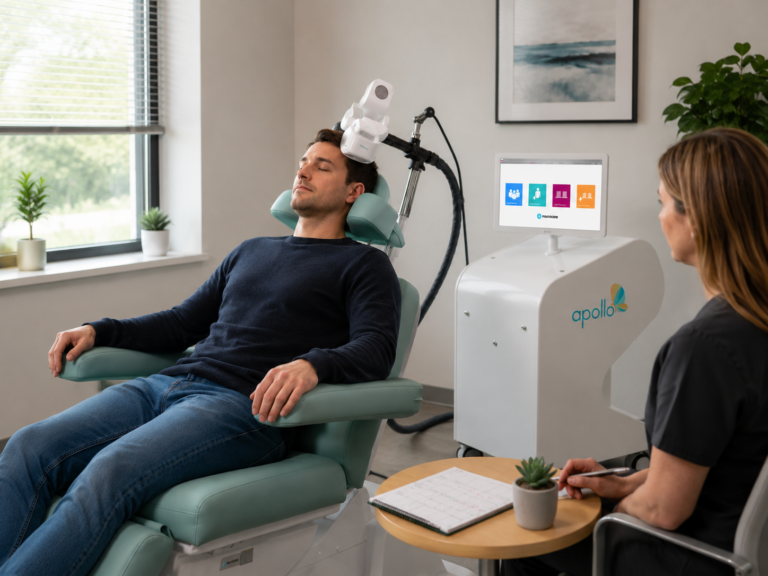
TMS — Transcranial Magnetic Stimulation — is a non-invasive, FDA-approved treatment that uses magnetic fields to stimulate specific areas of the brain involved in mood regulation. It requires no anesthesia, no recovery time, and carries minimal side effects compared to ECT.
You’re right — here’s the full updated blog with source links added to every statistic:
Recovery Shows Up in the Quiet Moments of Everyday Life

What this patient’s story captures — better than any clinical scale can — is that depression recovery doesn’t always announce itself with sweeping changes in severity rating. Sometimes it’s tasting garlic sauce. Sometimes it’s dreaming again. Sometimes it’s turning to a spouse and saying, let’s go somewhere.
These aren’t trivial wins. They are evidence that the brain is healing — that neural pathways suppressed by years of illness are beginning to fire again. The return of taste, of sleep, of the desire to leave the house: each one is a sign that something fundamental has shifted.
Final Thoughts
There is a version of this story that never happens — where treatment-resistant depression is accepted as permanent, where the search stops, where a person continues to live half a life. This patient’s success story exists because someone kept looking for another option.
TMS is not a guarantee, and it is not right for everyone. But for patients who have tried and tried and still not found relief, it represents a real and evidence-based path forward. If a patient or their loved one is living with depression that hasn’t responded to medication, seeking other options is the step forward.
Depression is physical. Recovery is possible. And sometimes, it starts with actually tasting your food again.
Frequently Asked Questions (FAQs)
1. What is TMS and how does it work?
TMS (Transcranial Magnetic Stimulation) is a non-invasive, FDA-approved treatment that uses magnetic pulses to stimulate nerve cells in areas of the brain associated with mood regulation. It is typically used when antidepressant medications have not been effective.
2. Who is a candidate for TMS?
TMS is generally considered for patients with major depressive disorder who have not responded adequately to one or more antidepressant medications. A psychiatric evaluation determines whether it is appropriate.
3. How does depression affect physical sensations like taste and sleep?
Depression alters brain chemistry and connectivity in ways that directly affect sensory experience.
4. How long does TMS treatment take to work?
Many patients begin to notice improvement within the first one to two weeks, though the full course of treatment typically spans several weeks. Response varies by individual.
5. How long does TMS treatment take to work?
Yes. Animo Sano Psychiatry offers TMS as part of individualized psychiatric care for patients with treatment-resistant depression.
Responsibly edited by AI
Explore More


Animo Sano Psychiatry is now serving patients across multiple states. If you’d like to schedule an appointment, please contact us to get started.
Get Access to Behavioral Health Care
Let’s take your first step towards. Press the button to get started. We’ll be back to you as soon as possible.ecovery, together.