TMS Side Effects: What’s Real, What’s Rare, and What You Can Stop Worrying About

Caleb Whitenack, MD

Key Takeaways
- TMS does have side effects — but the most common ones are mild, manageable, and typically improve after the first week of treatment.
- TMS does not cause memory loss. This is one of the most persistent fears people bring to their first consultation, and the clinical evidence is clear on this point.
- Serious risks like seizures are real but extremely rare — occurring at a rate of less than 1 in 1,000 sessions in clinical data.
- TMS will not change your personality. What it can change is how you feel, which for many people means feeling more like themselves.
- The pre-treatment screening process exists specifically to identify people at higher risk — it’s the system working, not a reason to be alarmed.
If you’ve been researching TMS and walked away feeling like everyone is either hiding something or not taking your questions seriously, that’s a reasonable reaction. “TMS has no side effects” — you’ve probably heard some version of that phrase. It’s not fully accurate, and the gap between what people are told and what they actually experience is exactly why so many patients end up in online forums looking for honest answers.
So here’s the honest version. Yes, TMS has side effects. Most are mild and short-lived. A few are rare but real and worth knowing about. And some of the things people worry about most — memory loss in particular — are not supported by clinical evidence. Let’s go through all of it.
The Side Effects That Are Actually Common
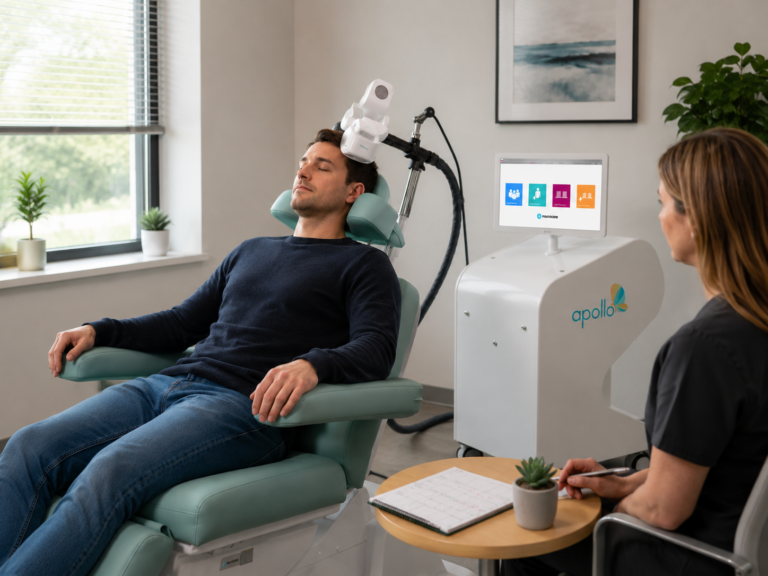
Headaches, scalp discomfort, facial twitching, and lightheadedness are the most commonly reported side effects of TMS, and they tend to resolve on their own as treatment continues:
- Headache — the most commonly reported side effect, particularly in the first week of treatment. For most people it’s mild and responds well to over-the-counter pain relief. It tends to improve on its own as treatment continues. Many times the headaches that occur at the beginning of treatment are tension headaches from tensing muscles due to not knowing what the treatment sensation is going to feel like.
- Scalp discomfort or tingling at the treatment site — a sensation from the magnetic coil that many people describe as tapping or mild pressure. It can feel strange at first but most patients adjust within a few sessions.
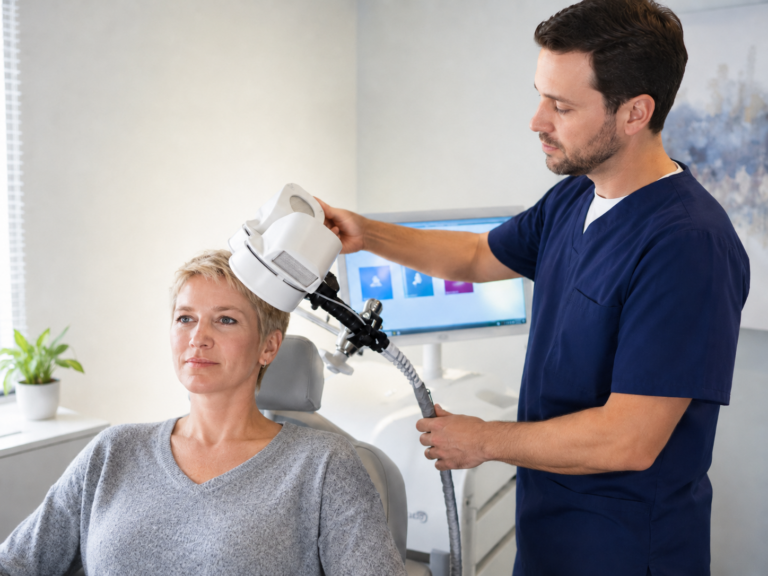
- Facial muscle twitching during sessions — the magnetic pulses can activate nearby muscles, causing brief involuntary twitching. It happens during the session itself and stops when the stimulation stops. Generally, the TMS team can adjust the angle of the magnet such that these twitches will stop.
- Lightheadedness — some people feel briefly dizzy immediately after a session. It’s generally short-lived.
- Fatigue — reported more commonly with accelerated protocols that involve multiple sessions in a single day.

None of these are trivial to experience, and we’re not minimizing them. But they are manageable, they tend to improve over the course of treatment, and they resolve completely when treatment ends. They’re also very different from the kinds of side effects that come with long-term medication use — there’s no weight change, no sexual dysfunction, no systemic effects.
Does TMS Cause Memory Loss?
No — TMS is not ECT. And this is worth stating plainly because it’s the question that stops more people from pursuing TMS than almost anything else.
The confusion typically comes from conflating TMS with electroconvulsive therapy (ECT) — a completely different procedure that uses electrical current delivered across the whole brain under general anesthesia, and which is associated with short-term memory disruption. TMS uses focused magnetic pulses to a specific region of the brain. The mechanisms, the experience, and the cognitive effects are entirely different.
A clinical review from the National Institute of Mental Health found no adverse effects on cognition in patients receiving TMS. This is consistent with the broader clinical literature, which has repeatedly confirmed that TMS does not impair memory or cognitive function. Some patients with depression actually report improvements in memory and concentration after treatment — not because TMS directly enhances cognition, but because depression itself is a significant cause of cognitive fog, and treating depression lifts it.
If you’re reading about what to expect during and after a full TMS course, it’s worth having that context going in.
Will TMS Change My Personality?
This is the second fear that comes up most often in patient communities, and it deserves an equally direct answer: No.
TMS stimulates a targeted region of the brain involved in mood regulation. It doesn’t alter the neural architecture that makes you who you are — your values, your relationships, your sense of self. What it can do is change how you feel. For people who have been living with severe depression, that shift can feel dramatic. Some patients describe it as finally feeling like themselves again rather than becoming someone different.
If anything changes about who you are after TMS, it’s typically that you have more access to the version of yourself that depression was suppressing — not a new person, but a freer one.
Serious but Rare: The Seizure Risk
Seizures are the most serious potential adverse event associated with TMS — and they are genuinely rare. A large survey tracking 318,560 TMS sessions across clinical sites found a seizure rate of 0.08 per 1,000 sessions. Among patients receiving TMS within standard clinical guidelines and without recognized risk factors, the rate was even lower — under 0.02 per 1,000 sessions.
To put that in context: the seizure risk from TMS is comparable to — and in many cases lower than — the seizure risk associated with several commonly prescribed psychiatric medications.
Seizures that do occur during TMS are typically self-limiting. If one were to happen, the TMS team would turn off the stimulation and the seizure would stop. Serious lasting harm is extremely rare.
Who is at higher risk? People with a personal or family history of epilepsy, certain neurological conditions, traumatic brain injury, abruptly stopping excessive alcohol use, drug use, or who are taking medications that lower the seizure threshold.
What to Tell Your Provider Before Starting

The screening questions you’ll be asked before starting TMS are not bureaucratic formality — they’re how your provider identifies whether you’re at elevated risk for any of the serious side effects. Be thorough and honest when answering them. Specifically:
- Any history of seizures or epilepsy in you or your family
- Any metal implants in your head or chest (pacemakers, cochlear implants, metal fragments)
- Any medications you’re currently taking, including supplements
- Any history of significant head injury or neurological conditions
- Whether you’re pregnant or trying to become pregnant
Understanding the full scope of what TMS involves, including this screening process, makes the experience significantly less uncertain — and that uncertainty is usually what’s most anxiety-provoking for people considering treatment.
Final Thoughts
TMS is not a side-effect-free treatment, and it’s better for everyone — providers and patients alike — when that’s said plainly from the start. The common side effects are real but manageable. The serious risks are real but rare. And the fears that stop the most people — memory loss, personality change — are not supported by the clinical evidence.
If you’ve read this far and feel more ready than scared, that’s usually a good sign. TMS treatment is more accessible — and more covered by insurance — than most people assume.
Frequently Asked Questions (FAQs)
1. Is it normal to feel worse during TMS treatment before feeling better?
Yes, for some people. A temporary increase in headaches, fatigue, or emotional intensity in the early weeks is a recognized adjustment response. It’s important to tell your provider if this happens rather than stopping treatment on your own.
2. Can TMS cause permanent side effects?
The clinical evidence does not support permanent side effects from TMS in patients treated within standard guidelines. Side effects are typically temporary and resolve when treatment ends. Serious lasting harm is extremely rare.
3. Is TMS safe if I’m already taking antidepressants?
For most patients, yes. TMS is routinely combined with medication. However, certain medications — particularly those that lower the seizure threshold — require careful consideration. Your provider will review your medications during the pre-treatment evaluation.
Responsibly edited by AI

Animo Sano Psychiatry is now serving patients across multiple states. If you’d like to schedule an appointment, please contact us to get started.
Get Access to Behavioral Health Care
Let’s take your first step towards. Press the button to get started. We’ll be back to you as soon as possible.ecovery, together.