
Why Your Anxiety Is Worse on Sunday Morning (And What to Do About It)

Jasmine Zaman – PA-C

Key Takeaways
- Sunday anxiety and morning dread are not random — they follow predictable biological and psychological patterns
- Cortisol, your body’s stress hormone, spikes naturally within the first hour of waking and hits harder in people with anxiety
- Anticipatory anxiety — dreading what might happen — often feels worse than the actual event itself
- When Sunday dread disrupts your sleep, mood, or ability to enjoy weekends regularly, it may signal something more than situational stress
- Understanding why it happens is the first step toward breaking the cycle
If Sunday evenings feel like the countdown to something dreaded, or if you wake up Monday already exhausted before the day has started, you’re not imagining it. This kind of patterned anxiety has real neurological roots — and it’s more common than you might think. Here’s why anxiety follows a schedule, and what that means for you.
Why Anxiety Has a Schedule
Anxiety doesn’t always strike randomly. For many people, it follows a predictable pattern — worse in the morning, worse on Sundays, worse the night before something demanding. That’s not a character flaw. It’s biology.
Your body’s stress hormone, cortisol, follows a natural daily rhythm. It peaks within the first 30 to 45 minutes after waking — a process called the cortisol awakening response — to prepare you for the demands of the day. For most people, this is a gentle nudge toward alertness. But research has shown that people with anxiety disorders experience a significantly larger cortisol awakening response, which means what should feel like a quiet start to the day can feel like an alarm going off before you’ve even opened your eyes.
Add Sunday into the mix — the gap between rest and responsibility — and you have a perfect environment for anxiety to build.
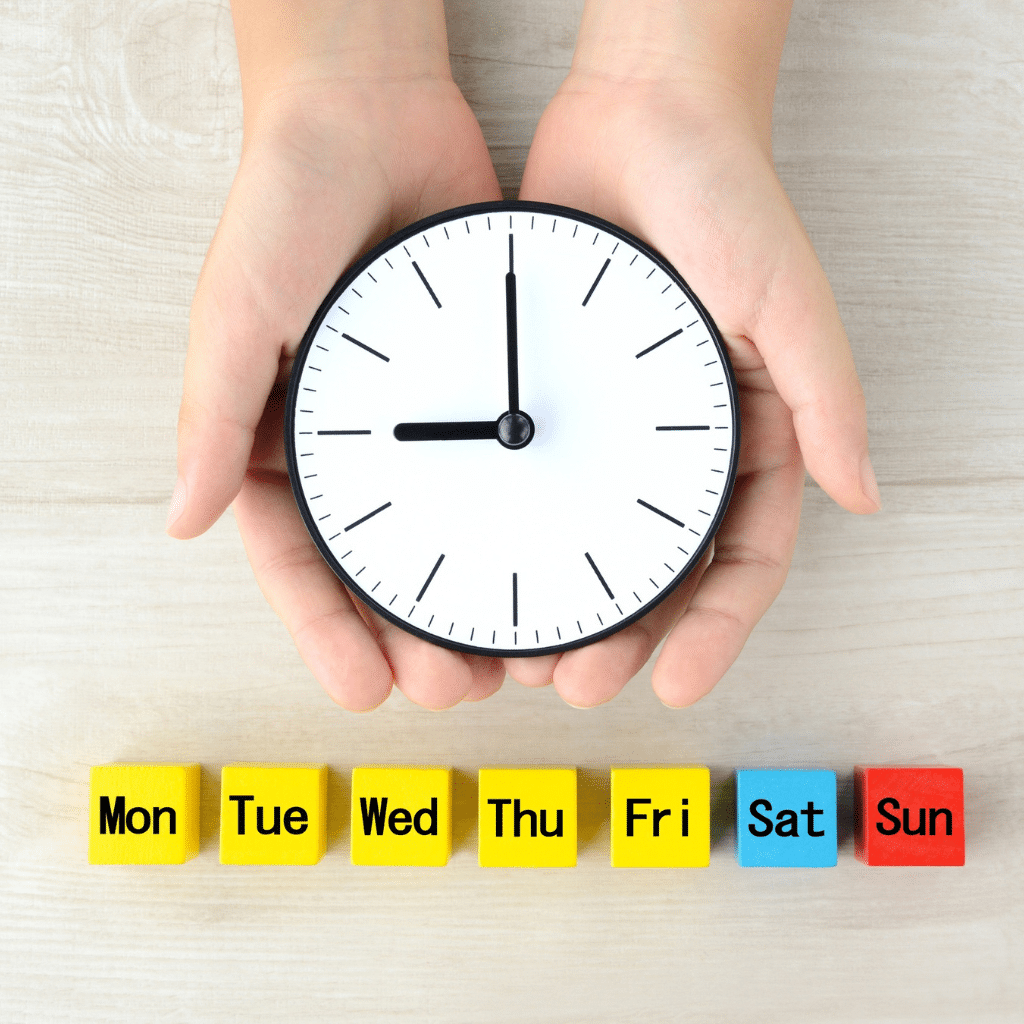
The Sunday-Monday Anxiety Cycle
Here’s what’s actually happening when Sunday dread sets in:
- The rest-to-responsibility gap. Sunday feels like it should be relaxing, but your brain is already scanning ahead to Monday. The contrast between downtime and upcoming demands creates a low-grade tension that builds as the day goes on.
- Anticipatory anxiety kicks in. The brain’s threat circuits activate more intensely in response to uncertainty than to known negative outcomes. In other words, imagining what Monday might bring is often more distressing than Monday itself — a pattern that’s at the core of how anticipatory anxiety works. Your mind fills the uncertainty with worst-case scenarios.
- Sunday evening cortisol shifts. As your circadian rhythm adjusts toward sleep, your brain chemistry changes — anxious thoughts feel stickier, harder to redirect, and more urgent than they did at 2pm.
- The anticipation loop. Dreading the anxiety itself — knowing you’ll wake up Monday feeling tense — can actually amplify your cortisol response before you’ve even fallen asleep. The dread feeds the cycle.
- Sleep disruption compounds everything. Poor sleep increases anxiety the following morning, and anxiety disrupts sleep. By Monday morning, you’re starting the week already depleted.
When Patterned Anxiety Is Something More
Sunday scaries are common. But there’s a difference between a weekly case of end-of-weekend nerves and something that requires more support.
Situational anxiety tied to a specific pattern — Sundays, Monday mornings, before particular events — typically eases once the trigger passes. Generalized anxiety disorder, by contrast, involves persistent and excessive worry that interferes with daily life across multiple areas, not tied to a specific time or event.
If your Sunday anxiety regularly disrupts your sleep, spills into Saturday, makes it hard to enjoy time off, or feels completely out of proportion to what’s actually happening at work or in your life — it’s worth talking to someone. That pattern is information, not weakness.
What Actually Helps
Understanding the biology gives you more leverage than willpower alone:

- Name what’s happening. Recognizing “this is my cortisol awakening response” or “this is anticipatory anxiety” gives your brain something concrete to work with instead of just spiraling.
- Create a Sunday wind-down routine. Reducing Sunday evening screen time, setting out clothes for Monday, or doing something genuinely enjoyable — not productive — in the evening can interrupt the anticipation loop.
- Don’t fight the feeling on Monday morning. The cortisol spike peaks and falls. If you can avoid making big decisions or catastrophic judgments about your day in that first 30 to 45 minutes, you’ll often find it settles on its own.
- Look at what Sunday is telling you. Persistent Sunday dread is sometimes pointing to something specific — a job, a relationship, a situation — that deserves attention beyond coping strategies. If anxiety and anticipatory dread are showing up consistently across different areas of your week — not just Sundays but as morning anxiety that follows you into the day — that pattern is worth exploring with a professional.
- Consider whether this is part of a bigger picture. Work anxiety that bleeds into weekends is one of the most common reasons people seek mental health support — and one of the most treatable. If anxiety has started affecting how you function day to day, speaking with someone who specializes in anxiety treatment can help you figure out whether what you’re experiencing is situational or something that would respond well to care.
Final Thoughts
Sunday anxiety isn’t just in your head — it’s in your hormones, your anticipatory brain circuits, and the very real gap between rest and responsibility. Understanding why it happens doesn’t make it disappear, but it does make it less mysterious. And for a lot of people, that’s the beginning of actually changing it.
If the Sunday scaries have become something you dread more than Monday itself, it may be time to talk to someone. Our 15-minute no-cost meet and greet is a good place to start.
Frequently Asked Questions (FAQs)
1. Is Sunday anxiety the same as generalized anxiety disorder?
Not necessarily. Sunday anxiety is often situational — tied to the transition from weekend to workweek. GAD involves persistent, excessive worry that isn’t limited to a specific time or trigger and affects multiple areas of life. If your anxiety is mostly confined to Sunday evenings and Monday mornings, it may be situational. If it’s showing up most days across different areas of your life, it’s worth getting a proper evaluation.
2. Why do I wake up anxious even when nothing bad is happening?
Your cortisol levels spike naturally in the first 30 to 45 minutes after waking. In people with anxiety, this spike is amplified, which can produce feelings of dread or unease before your conscious mind has even registered the day ahead. It’s a physiological process, not a sign that something is actually wrong.
3. What’s the difference between Sunday scaries and burnout?
Sunday scaries are typically anticipatory — they’re about what’s coming. Burnout is more cumulative — it’s the result of prolonged stress that hasn’t been addressed, and it tends to show up as emotional exhaustion, cynicism, and reduced effectiveness even when you’re not thinking about work. The two can overlap, and both benefit from professional support.
Responsibly edited by AI



Animo Sano Psychiatry is now serving patients across multiple states. If you’d like to schedule an appointment, please contact us to get started.
Get Access to Behavioral Health Care
Let’s take your first step towards. Press the button to get started. We’ll be back to you as soon as possible.ecovery, together.